Saturday, July 28, 2012

A book is a book is a book... right?

Most creative amateurs who strive to make something, agree that the way to improve is to learn from professionals. I say most because there are a significant few who have the idea that they have some mutant creative power whereby they know better than the people who have invested a significant portion of their lives to learning their craft, in most cases take pride in their achievements and do it so well that people will pay them to do it.

When it comes to publishing, I am strictly Little League! Certainly I try my best to present an author's work in its best light and I have some specific ideas and guidelines that this work allows me to experiment with, but I am a realist: the fast-track to success lies in learning from the experience of those who have 'been there and done that'.

Luckily a thriving community has grown up around the concept of self-publishing, the idea that authors can publish their own books. I've mentioned before the Self-Publishing Yahoogroup, which is a prolific and supportive group of authors and small publishers, but arguably the most helpful and authoritative website would have to be Joel Friedlander's, The Book Designer. With information ranging from obscure but important technical details to general commentaries on aesthetics, Joel shows a depth and breadth of knowledge in his field that makes his website required reading for anyone interested in the subject.

One of the recurring themes that Joel puts forward is that eBooks as they stand are a danger to hard-copy books, that they are the Death of Book Design and "Do Violence to the Concept of a Book"...


Whilst Joel is not a one-eyed hater of eBooks, a lot of this is tongue-in-cheek and he has in fact got a substantial section on creating eBooks in his 'Start Here' section, his professional career revolves around creating beautiful books and he recognises that this is something that eBooks are not set up to allow. I believe I see Joel's point and if I may paraphrase, I see it as a case of the same content being distributed by different media - eBooks and hard-copy books. How, you might ask, can they be different media? They both convey the written word of exactly the same text, and that is precisely the point: they convey the same content but as an entirely different experience.
Let me give you an example.
The last hard copy book I bought was "El Borak and Other Desert Adventures", a collection of some of Robert Ervin Howard's pulp adventures set in the Far East illustrated with copious internal black & white artworks by Tim Bradstreet and Tim & Ruth Keegan. However I live in Australia where pretty much all of these stories are now in the public domain, so I could have downloaded them all from Project Gutenberg Australia as either txt files or html - so why did I buy this book?
Well, besides the glaring editing errors? Whoever had submitted "The Daughter of Erlik Khan" to Project Gutenberg had failed to note that the opening section was probably a promotional text from the flyleaf and that the closing chapter, "chapter 11" was in fact the opening section of another story, "Swords of the Hills" - probably more promotional text from the inside back cover! Could it be the superlative artwork? The quality construction of the trade paperback? The collector's passion of owning the stories that I loved? The nostalgia factor of holding in my hands lost hours from my youth?

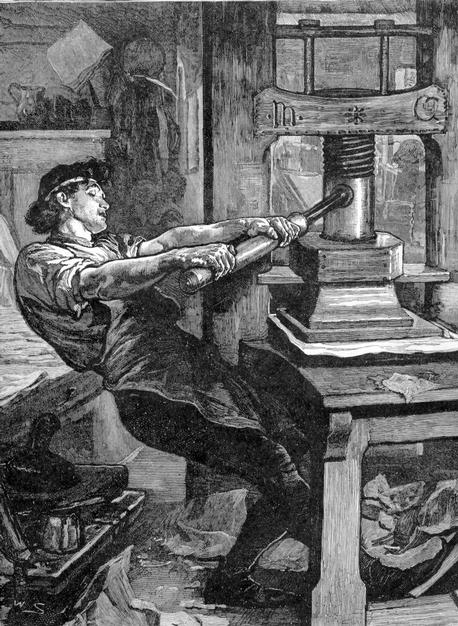
I bought an experience. I gained a possession, something that has an intrinsic meaning for me. Books are more than just the content, the words which the author has strung together so skilfully. They are an artifact, crafted by book designers, to enhance your reading experience and, yes, design does matter!

So why, if we are to believe Joel, are eBooks such an antithesis to good book design? In their current form, nearly all the individual factors that the designer utilises to make them individual are now arbitrary, at the whim of the reader or severely limited in choice. The font, its size, the page size and orientation - they can all be changed by the reader or are dictated by the eReader. This in turn affects the page  numbering, the flow of the text, where page breaks occur, the position of illustrations and the amount of white space at chapter ends.

Joel is arguing semantics of what a book is and I can see his point of view, that an eBook is only slightly closer related to a hard copy book than it is to an audio book, that it's medium is the electronic file and not the printed word.

But is this the end of the story? Two choices? Hard-copy or eBook? I don't believe so. 

Because TrekUnited Publishing publish fan fiction I will almost certainly never see anything printed in hard-copy under our imprint . We've published ePubs and Mobis in the past, courtesy of Richard Merk's help, and I intend working on more in the near future, but...

[Cue suspenseful Star Wars music] There is another!

[Fade to black. Roll credits.] To Be Continued!

The Crossroads

The printing and publishing industry stands at a crossroads at the time of writing.

Major book retailing chains in Australia and the United States, are trying desperately to “trade out” of what could amount to receivership. Many blame the changing face of publishing brought about by the computer age and the internet in particular and there can be no doubt that the public's buying habits have changed dramatically.

Our lives as readers have changed. Whereas in the past I would spend my afternoons ensconced in the local library or buying comics from my local newsagent, now I am more likely to find my reading material online. In the not-so-distant past my only option for buying books would be a bookshop, either the small local shop or one of the specialist stores in the city. Today, the physical limitations of getting my reading material have all but disappeared. Book not available locally or in Australia? Out of print? With the click of a few buttons I can search for and buy a far wider range of books, in most cases at a more competitive price as well.

I love books and reading. My house and every available storage space in it is filled with hardbacks and paperbacks ranging from a family heirloom, Sunday School prize of my mother-in-law's to a new hardback best-seller I bought for my birthday.

I have a lot of sympathy for the printing industry and I feel that they are the victim of being dependent on the publishers who are now abandoning them in favour of new manufacturing and distribution practices. Authors need to think outside the square and avail themselves of the myriad of options that are open to them. Publishers are no longer the omnipotent Gods of the publishing pantheon! The tyranny of scale that made them the sole providers of mass produced books for the common folk have been broken by new technologies and business models.

On the one hand we have seen them all but replaced by the new leviathans of online commerce – Amazon and Barns & Noble. Shopping from home, I can browse a catalogue that not only holds the latest best-sellers but the obscure titles of an author's back-list. I can order a copy in any format it has been released in: hardback, paperback, audiobook, video or graphic novel. I have to wait for it to be mailed out to me and freight is an added expense but if price is an issue I can often get second hand copies at ridiculously low prices.

This is the mass-marketing approach that is the equivalent of the 'convenience food' outlet, but when a Macdonald's moved into your town, did all the restaurants go out of business? No, they survived by focusing on the niche market, those who wanted an intimate, personal service.

I believe we will see the rise of specialist or "boutique" printers in the same way that small breweries, bakeries, and wineries have found that they can prosper by providing a quality, exclusive product rather than competing with the multinationals for the bulk, mass market.

Friday, June 8, 2012

Originality in Fan Productions

Lack of originality is another defect that is pinned on fan productions and I will go so far as to say that breathing originality into *any* derivative work, irrespective of whether it is fan-made or professional, is one of the many major challenges a writer and producer is faced with.

As regards the originality of fan productions, I don't believe you can just throw out a blanket generalisation over them all because some are more susceptible than others.

As I've said before, your base level fan fiction author couldn't give a Tinker's what you think of their work because they are doing it for their own satisfaction and although they will be pleased if you complement their work, they aren't really interested in your critique because they didn't write it to exercise their art and are not interested in trying to improve. I'll not condemn them because writing for any purpose can lead to bigger and better things and bring them closer to the realisation that there might be a bigger audience than one for their work and will some day start to listen to critique which will lead them onto the path towards learning how to express themselves better.

You might have noticed that I have made the distinction between fan productions that use Canon characters and those that use OC's or Original Characters? This is no idle speculation, it is at the same time one of the things that frees us and a responsibility that binds us.

I very seldom do anything with canon characters because to write something that develops our appreciation of them is hard, *very* hard. I do however use canon races, settings, technology, backgrounds, etc so I'll stand up and be counted on that part. Have I used them with originality? That's for the audience to say, I suppose. I've had positive feedback, from die-hard fans as well as audio buffs, I am only one part of the small cast and crew who made it what it is but in general I think of it is something I'm proud to be associated with.

Star Trek Excelsior, Outpost, Eras, Henglaar MD - there is quite a healthy list of Star Trek fan audio dramas thank you very much - are examples of fan productions that use OC's and yet the canon details that they are built on are meticulously checked to make sure that they conform with the ideas of the original writers. The Klingons are honourable and warlike, the Vulcans are logical and unemotional, the Feddies are driven by an ethical code of conduct whilst playing the wildcard of humanity.

The Star Trek universe was created by professional writers, actors, designers and producers using an investment of hard cash from the entertainment industry which means that, no matter how loosely your production is based on the copyrighted work, it is still a fan production and as such must be bound by the fan production rules of engagement - no diverting revenue, all credit acknowledged...

How much harder is it to reconcile making a derivative work using canon characters? To my mind that is an immense task and, if done well, adds immensely to the franchise - done poorly, it can ring its death knell!

I'll admit to being a Batman fan. The tortured, brooding character is iconic. I was entertained but only occasionally impressed by the early movies, I was stunned by the Batman Begins reboot, I've listened to some of the OTR classics and I've heard promo excerpts from Dirk Mag's Knightfall which one of these days I've got to buy a copy of. I enjoyed Pete Milan & Seth Adam Sher's Ace of Detectives (a finalist for a 2007 Parsec Award) and I absolutely loved Laura Post's Batman: No Man's Land, which has been sadly in abeyance for two years.

Why did the early movies fail to convey the essence of the Dark Knight when the fan productions did? Because the studio played it for kitsch, they thought the public wanted an entertaining Batman and so they gave them a Batman (Val Kilmer) who actually smiled once! It was only with Batman Begins that they actually started to show the character the respect it deserved and were rewarded by critical acclaim.

Therein lies the crux of creating something based on an earlier work, especially something that was successful or has a strong fan following - you have to find the essence of the character/s and create something that respects that core and develops on it.

This is the usual failure of baseline fan fiction because a fan will generally want to write something that shows a character as they would like them to be and in so doing flies in the face of canon. Spock loves Kirk, the Emperor Palpatine cries, Dante from Devil May Cry becomes a Pokemon trainer! Yes, it has all happened in the fertile mind of a fan but is it Trek / Wars / DMC? Hey, I believe in IDIC so do whatever turns you on baby, just don't expect me to include it with fan productions that attempt to address their canon with some degree of accuracy. In the over-the-top world of Star Wars, the Emperor Palpatine, certainly in ep's 1-3, is as caring-and-sharing as Atilla the Hun! Works that make no attempt to rationalise these changes of character are called character rape by the unkind and I find them hard to defend.

The three times I can remember writing something using Trek canon characters I have tried to write about them based on my understanding of them from canon but taking it just a little further. I would no more have one of the canon characters I have gained so much enjoyment from do something out of character than I would write a lie about a real person.

So does that mean we need to regurgitate carbon copies of canon episodes? That would indeed be unoriginal but using canon characters to say something new? Why is Nechayev such a hard case? What would it have been like at the Court of Inquiry into the loss of the Enterprise-D at Veridian 3? What would happen if...? What happened next? Why didn't they...? What are the consequences of...?

Hard to do in Star Trek but even harder in any franchise that depends on the characters for its driving force: Buffy is a perfect example because without those central characters Sunnydale is just the same as any other Hellmount!

I suppose my point is that originality of premise, whilst creatively admirable, is not an automatic ticket to greatness just as it should not be assumed that it is impossible for a derivative work to be original. I've listened to some Indie audio dramas that have laboured valiantly to create an interesting, original fictional setting for their work and just not made it, whilst I've also heard some fan shows that either re-captured the original nicely or took them in new directions... and vice versa!

Whilst I will admit to open admiration of anyone who creates an interesting original fictional setting are we saying here that anyone's work which is based on another's fictional setting is to be automatically castigated? Dirk Maggs' Batman? Joss Whedon's Avengers? Joss is not averse to wanting to place his own personal stamp on franchises that he admires and I dare say the suits at DC are collectively kicking themselves for not letting him have his way with Wonder Woman... creatively speaking of course!
Talk to me of originality and, I will turn on you with rage. I am a crowd, I am a lonely man, I am nothing

On The Honesty of Star Trek Fan Productions

Fan productions have a number of innate advantages over professional work. Being free from commercial restraints is one such boon – I only have to worry about what I want to put into my creation, not what my audience demands. If I wish to write a political polemic that espouses the virtues of Ferengi existentialism I don't have to worry that it won't sell! We can, and many do, put whatever message we want into our fiction without worrying about the interference of media executives.

Because my work is free from the need to be a financial success I can take any chance I desire without worrying if it will make enough money from the mugs and mouse mats I might be selling from my website to pay for the server costs for the month.

If I am confident about what I am trying to do, I can call down to the Engine Room, “Full speed ahead and damn the critics!”

Without belittling the required technical knowledge needed to be a critic, all too often their reviews are not constructive and survive on the public's vicarious enjoyment of their negative attitude. All to often they use the cheap-shot yuks of Mary Sue jokes to take a holier-than-thou attitude towards fan productions. Alas, they suffer from the same commercial imperative as others who see their work as a salable commodity: their purpose is not to improve the work of those being reviewed but to entertain the public and in so doing improve their Alexa web ranking.

Years ago I wanted to write an audio drama series that dealt with the themes of aggression, bravery and honour - Tales of Death and Honour - and I chose to build my premise on the diametrically opposed cultures of the Klingon and Vulcan in Star Trek. Knowledge of he TV program and movies is so pervasive throughout Western Society and beyond that there would be few who can read the English language who would not have a working knowledge of it! The very names are synonymous with the concepts of aggression and honour as against pacifism and logic.

[sighs] So why not do the same thing based on your own fictional universe, I hear you say? Because my story requires that I use these two memes, because if I tried to make my own fictional universe that could do the same thing, all I would be doing would be copying the Star Trek universe and giving it different names. That, dear reader, is true plagiary to my mind!

I will accept the slings and arrows that say this is a cop-out and my only defense is that I'm a Trek fan who has such an immense respect for the fictional universe which the professionals have created that my own creative processes march in synch with theirs.

Like most Star Trek fan producers, as I've said before, for the most part I don't use canon characters - all my characters and situations are original and simply use the Star Trek fictional universe as a framework. However my work is still a fan production and I must acknowledge my debt to those professionals who made the fictional universe - the memes of Klingon and Vulcan - so engrained in popular culture. The actors, the costumers, the prosthetics makers, Marc Okrand and a dozen different writers, directors, producers, Paramount, Desilu and The Great Bird of The Galaxy.

So, in answer to the question how do I rationalise using someone else's Intellectual Property to tell my own story, all I can say is that I honour the purpose of the law rather than the letter of the law. The purpose of the law is to provide a mechanism of monetary return to the creator to recompense them for their work. The copyright owners and licensees of Star Trek have made a small fortune out of me over the years by my purchase of books, merchandise, role playing games, movie tickets, costumes (yes, I am the proud owner of an Enterprise era uniform that I will be wearing to Supanova this year) and all I ask in return is that they allow me to develop my fandom along creative lines.

Douglas Bader in Reach For The Sky says, "Rules are for the obedience of fools and the guidance of wise men." Rules are created for a reason - find out what that reason is, address that problem and then you have honoured the rule. The purpose of copyright is to either make money for the creator or to make sure that they do not lose any money that they might otherwise make.

If I do NOT write my audio drama series it will not make one extra penny for Paramount. I am not given any realistic mechanism for paying Paramount for using their IP. I could buy a license but since I don't have a six-figure sum sitting in my back pocket this is unrealistic. If I could pay Paramount $10-$50 for a mini-license to write a fan production on the proviso that I make no profit on it, I would be delighted to do so but I can't.

So if I want to exercise my fan experience creatively as an audio drama I have two choices: give them indirect profit and ensure that no money is diverted from them that they would otherwise make.
  • My story supports their fictional universe, develops it and, hopefully, enhances it.
  • By doing so it keeps interest alive in their IP so that existing fans will continue their support of the franchise and new fans will be introduced to it.
  • This is viral promotion - something that professionals paid thousands are struggling to do for them commercially. I give it to them for free.
  • Nothing that I do generates any revenue - I don't have any Tales of Death and Honour T shirts, mugs or mouse mats for sale. If I did, these could be seen as a revenue that is trading at least in part on their IP.
  • In the same way, I don't have a tip jar for myself or a charity (more's the pity) because these could be seen as a revenue that is generated in part on their IP.

Yes, I am using their Intellectual Property but I'm given no realistic way of paying for it, so I use it in a way that gives them indirect revenue and does not divert revenue from them. All I ask in return is to add a rider to my work: "The author reserves the moral right to be identified as the creator of any original work." This is not just ego on my part, it also safeguards them if my work generates any negative publicity. If the public thinks it is crap, its my fault but if it is good I would ask that my original contributions be acknowledged.

Not too much to ask I think.

By the way, with regards to usage of canon characters, I've since remembered that the audio drama, Star Trek Grissom uses canon characters and extrapolates on the classic movie era storyline leading up to The Search For Spock. However the characters are a small part of the whole production and the audience's foreknowledge of the Grissom's tragic fate gives the whole production a dramatic flare that tinges our developing love of the characters. Only an Irishman could think up this!

Friday, May 4, 2012

Writing For The Media 1: Graphic Novels

Its not immediately apparent that the same story needs to be written different ways to suit the media.

One of the best investments I ever made was to buy a copy of Straczinsky's Scriptwriting - invaluable advice from someone who has produced works in all the disciplines he writes about: film, TV, stage, radio, animation... For each of them you, the aspiring author, have to follow certain rules to avoid the common pitfalls and make the most of the strength's of each medium.

A comic or graphic novel, for example, has to be written to deliver its story via words and pictures, so the successful comic or graphic novel creator needs to pay equal attention to both. Ever read a comic book adaptation of a film and wondered why it is different in subtle details from the original? Its because things that are impressive on the screen don't always translate well into two dimensional graphics, for example an action sequence, and conversely there are ways that a comic can go beyond a film, for example by verbalising thoughts or emphasising the 'God view'.

By the same token, you need to be an artist as well in that you need to create a story on the page that conveys the plot as effectively as possible, creating images that bring the storyline to life for the reader. To do this you need to design the impact of the page usually, but not always, done with a storyboard, even before you start creating the graphic resources to make up your panels.

By graphic resources I mean the pictures and this used to be the sticking point for amateurs in the past. Dreaming of breaking into comics meant paying your dues at art school, developing skills in sketching, inking, colouring, learning about composition, anatomy and the use of light and colour. If you weren't planning on taking it up professionally, it was too much for an amateur to take on.

As with many skill-sets from the past, technology has come to the rescue of the modern Everyman. Don't get me wrong, there are many amateur artists who have the skill and talent to use pencil, pen and colour to create comics on paper and I am truly in awe of some of the work I see on deviantArt today. For the rest of we mere mortals, there are drawing aids that show that you are using your brain as well as your artistic talent.

I, for example, have used rotoscoping effectively to help me with composition and anatomy but it is by no means the only reason for using a light table. If you go the traditional pencil - paper - pen route, a light table was generally used to turn a rough pencil sketch into 'tight pencils' and later, with a clean sheet of paper, to the final inks as shown by Clay Butler on his tutorial of how he has drawn his comic strip over the years. Paul C. Stauffer III also has a good Youtube video - be sure to check the comments.

Computer graphics software are the new light box! You've got more ways to go than you can shake a stick at!

I'm lucky to be associated with two rather talented graphic novel creators who work in Bryce/Poser/DAZ. It's popular, it can give you a close to photo-realistic finished product, but it is by no means the only way to go. Machinima - using a game engine to capture your graphics - is even easier and fans have used programs ranging from Star Trek: Elite Force to Star Trek: Online - Ray Martin has done some great work on Star Trek: Saladin and his STO comics are under his third era at the bottom of the page. You can read how they do it plus browse another webcomic on the STO forum HERE.

Of course, I wouldn't try to do it yourself. Just as you probably couldn't voice the audiobook version, animate the cartoon, program the video game and write the music for the opera of "Knight's Haven", you'd do best to find the best designer and graphics editor you can.

How would *I* do it? Ah! Now that would be telling!

Friday, April 27, 2012

The Producer's Chair

I am by no means an expert at being the head of a production but I base my ideas regarding the group dynamics of project management on Larry Nemecek's management style when I worked with him on SciFi Studios Magazine, which I call the "Conductor" approach...

When people go to an orchestral recital they go for the experience of listening to an orchestra. They don't go to listen to the piano, the brass section or the clarinet player, they go to listen to the whole orchestra. This means that the orchestra has to perform as a group - they have to be in time and in tune. As the brass fades out, the strings fade in with the percussion giving a subliminal beat to it all. If one section of the orchestra is bad then the whole production suffers. If the percussion is out of time or the piano out of tune, then no matter how good the strings are, the recital will get bad reviews.

The conductor doesn't just wave his baton to keep them all in time - watch him next time. You'll see him point to the lead violinist when it is time for him to start, he'll wave in the cellos when they have to come to the fore and punch a fist to the base drummer when he has to give a roll of thunder. During a practise if any of the sections or players doesn't follow his direction, he'll stop the orchestra, talk to them, maybe get them to run through their section and they will re-start. He'll work with the individual sections and with individual players as required.

This goes beyond talking about the interaction of people in a project, you can include all the resources of a project in this analogy! Imagine that the strings are the visual aspects of the production, the wind might be the audio, the brass is the promotion and the percussion the content, for example the script. Just as the conductor chooses the members of his orchestra, the producer of an animation will choose his animators, his promotional agent, script-writer and voice actors. These are the manpower resources of the project, to which are added the infrastructure resources such as software, special effects, music, etc.

Once chosen the conductor's or producer's job is to maximise the efficiency of every aspect the "orchestra". In the case of infrastructure the responsibility for their efficient use lies with the production staff who use them, for argument's sake we'll say the producer, but for manpower resources - people - he has to work *with* them to encourage them to produce their best. This might require him to give direction sometimes, as in "Jenny, your character is a Klingon warrior - I need more raspy, gutteral lower registers." However he CANNOT do the performance himself, all he can do is help and encourage the performer. Your pianist might be the best in the country, but in the context of this production, he takes his direction from the conductor.

I can't stress that highly enough. The conductor can't play every instrument because frankly that's not his purpose. He's there to lead the whole orchestra to encourage them to give their very best in the performance, to act as quality control by giving them feedback on what they are doing and to give them direction to perform their role in this particular performance. Just as a musician auditions for a spot in an orchestra, a voice actor auditions for a spot in an audio drama and a writer will pitch their story for inclusion in your anthology. They sign on because they want the gig, because they want to perform Bach or Beethoven, it might be because they want to expand their creative horizons, or, if they are a professional, because they want the money. They want to give their best, if they are a pro it might be because they have to protect their reputation, as an amateur its because of the like to play their instrument, they enjoy being part of an orchestra and they want to "push the envelope" creatively.

Performers perform, actors act. This is in their nature, this is what you sign them on board to do. To sign them on and then not allow them to act, to control the lift of every eyebrow, flies in the face of reason. If you want this kind of control then you need to think very seriously about whether you want your project to be a group production or a one-man-show. This is a viable option - Geoff James' Borg Wars is the perfect example - but it is more labour intensive, slower and, unless you are a Renaissance man, there is a very real possibility that an aspect that you are weak in will drag your production down unfairly.

If you choose to make your project into a group endeavor then you are still the prime-mover for the production but you have to learn to delegate work without micro-managing. Give direction and quality control to keep all the individual parts of the production, the performers in the orchestra, working together to deliver the best possible result, but allow the individuals involved to give creative input, respect what they do and give them credit for it on the night.

When I publish a magazine, I work with the individual artists and authors to get them to deliver their very best. If an artist is doing the cover art for a story, I have to make sure the two match - a line art of Kirk in the foreground with Spock looking on will be totally inappropriate for a story which is all about Spock and where Kirk only has a walk-on part. However I can't control the pen that does the sketch, the airbrush that gives it colour or the mind that writes the story, all of these things have far more to do with the success of the 'zine than my editorial direction.

When I write scripts for an audio drama, I'll add a single word to a line of delivery to show how I want the line delivered: angrily, slyly, sneeringly, whispered, with awe, testily. I might give more detailed direction when I hand the lines out: "try to exude strength of character even though totally exhausted" was one I gave one time and astonishingly the VA gave me exactly what I wanted! In fact she added something to it that I had never considered and thus made it that much better! Your cast and crew will deliver more if they are encouraged than if they are ordered.

So whether you are shooting a film, publishing a newsletter or coaching a football team always keep in mind that you are part of a team and that your contribution is simply to keep the group's overall performance on track for achieving your goals by encouraging all the individuals involved to deliver their part to the best of their ability.

They might throw roses at your feet but you have to share every bouquet with your ensemble.

Tuesday, April 24, 2012

Book trailers - Virtual book covers?

This post came about in most circuitous manner! The idea was stimulated by a correspondence thread on the Self-Publishing Yahoo Group that led to a great article about Scott Sigler which made me update the ol' House L'Stok YouTube channel and make up a playlist of examples to help me crystalise my thoughts on them. These are my choices below, three top-line professional jobs, Scott Sigler's semi-pro and a first-time DIY job.... 


So what are they? I mean, obviously they are promotional pieces to entice the viewer to read the book they promote, but *how* do they do it? If we know this we can assess what is needed to make an effective book trailer.

Traditionally, promoting a book was the job of the book itself, its physical "packaging" if you will - the cover, the spine, back cover and dustcover flaps. These were where you would get the promotional blurb about the book, the author and the series or fanchise that it was a part of.  This sent me off on a tangent defining my thoughts on book covers and, since it is vital to the artistic direction of our books, I've posted the result on our deviantArt account, "On Book Covers"

What struck me the most was that, of the elements that I mentioned - cover, spine, back cover and dustcover flaps - only the front cover exists on an eBook! Now, you can do a lot with a cover, identify the fanchise, the genre and make a unique statement that can draw the reader, but there is a lot that you've dropped. What about all the material that was covered on the back cover? Often you'd get a continuation or wraparound graphic from the front, two or three paragraphs of promotional text and icons that would show the trademarks, copyright, age classification, prequel/sequel info... A relic of the hardcover, the inside back flap was the domain of information about the author, usually presided over by a cheesy photograph. All of this information was there in the reader's hands when they picked it up from the bookshelf. How is an eBook reader going to get that kind of in-depth information?

Could a video book trailer take their place?

[To be Continued]